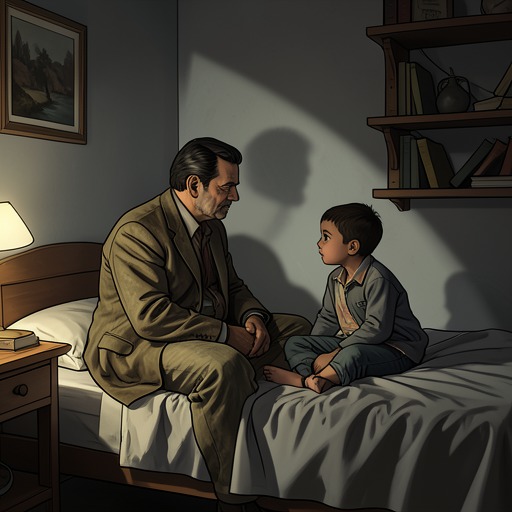
Kido sees and dismisses the suspicious notification Kaori received
A ManKido sees and dismisses the suspicious notification Kaori received in a brief domestic scene whose tension lies in what he chooses not to do. A message from Kaori’s boss appears on Sota’s phone; Kido reads enough to register its suggestive wording, removes the banner without comment, and places the phone face-down. The scene makes suspicion present but unresolved, turning an ordinary interruption into a test of attention, restraint, and what a marriage can leave unasked.
The Phone and the Interruption
At lunch, Sota asks Kaori to let him play a puzzle game on her phone. When she asks for it back, he is absorbed in the screen and does not seem to hear; after hesitating, Kaori lets him keep it and goes to the restroom. The device thus passes from mother to child and then into Kido’s hands, creating the accidental route by which a private message becomes visible to him.
Sota suddenly calls Kido’s attention to a strange screen. It is an advertisement for another game, and Kido assumes Sota has pressed something by mistake. As he taps to return to the puzzle, a Line notification appears across the top of the display. Kido has not gone looking for Kaori’s messages, but the banner enters his field of vision before he can avert his attention.
What Kido Sees
The notification is for an incoming message from Kaori’s boss. Around the words “Last Night” are heart emojis in the style of children’s stickers. The text is brief and ambiguous: it does not disclose what happened, but its wording and the sender together make the message difficult for Kido to regard as neutral.
Kido swipes the banner away with his thumb, gently, as though brushing dust from something fragile. The gesture is automatic enough to remove the notification, yet the sender’s name remains in his mind after the message disappears. His attention has taken in more than he intended, and clearing the screen cannot clear the suspicion the glimpse has raised.
Dismissal and Uncertainty
The narration stresses Kido’s effort to treat the moment as inconsequential. He tells himself there is no reason to suppose the event has moved beyond short-term memory and imagines that it has vanished without a trace, like anything that need not be remembered. The phrasing exposes the gap between his attempted dismissal and the detail he has retained: the sender’s identity and the suggestive words are already lodged in his thoughts.
When the display goes black, Kido places the phone face-down on the table as though nothing has happened. He does not confront Kaori, inspect the message further, or draw Sota into it. Instead, he returns the scene to its outward routine, telling his son that the game is over because lunch has arrived. The phone’s reversal—from screen visible to screen hidden—enacts that choice to close off what he has just seen.
Significance
The episode ends without explaining the message or establishing its meaning. Its force comes from the contrast between accidental discovery and deliberate nonresponse: Kido sees enough to become uneasy, then behaves as if the information can be put away with the device. The scene therefore leaves the marital question suspended rather than resolved, while making his restraint itself part of the tension.